Showing posts with label History And Theory Of Design II. Show all posts

12.10.2010

POINT: EXPLORATIONS

"Architecture is the will of an epoch translated into space."

-Ludwig Mies van der Rohe
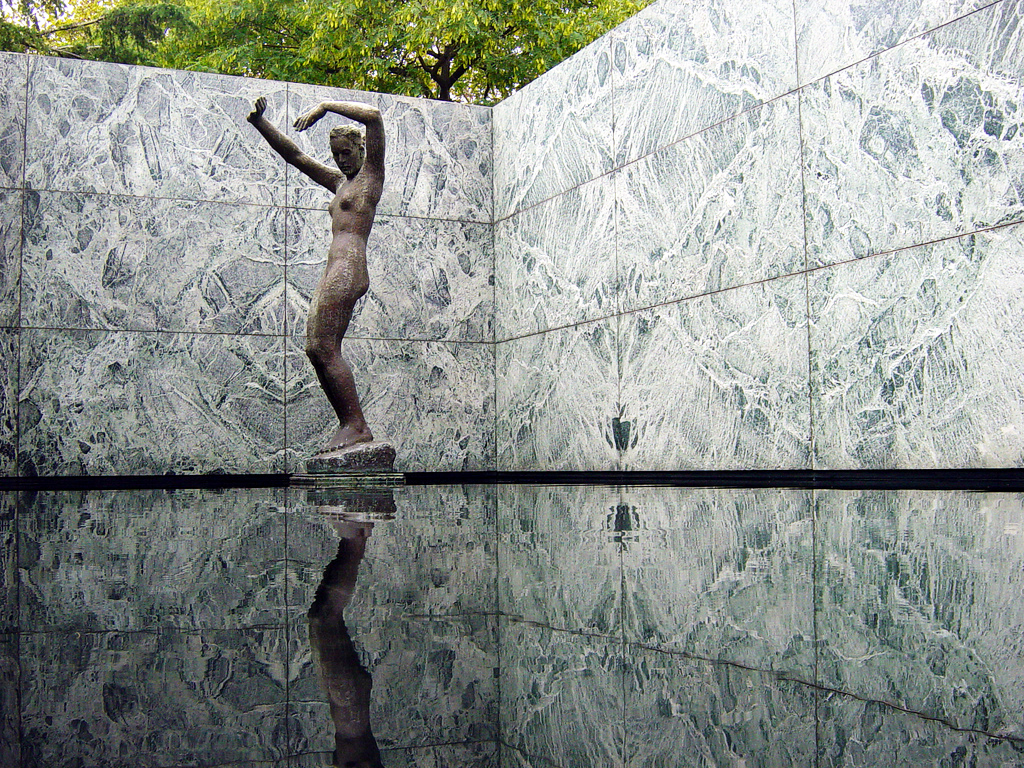

Moving away from the reflections section of our class, we dove right into the explorations unit which is where we still lay in present day. The explorations unit was about figuring out to me who you were as a designer, figuring out what it all meant to you. What people now days call “modern”, this is where I believe we find our definition of that very word. Looking all the way back to the Bauhaus even, it was an idea that any person could come and get education in different areas of the fine arts. Not even having an established architecture program during its first years of existence, it was an idea that all of these fundamentals could be brought together under one roof. With explorations and a new century, new materials and technology arose creating debates on what was deemed appropriate and the true right way. Some of these materials were metal, glass and concrete which made way for the second/first city... Chicago. After Chicago, New York started to appear creating yet another ideal city full of architectural richness. Within the explorations unit, styles started to arrive in these cities such as art deco and post-modernism. The art deco theme that presented itself in the Chrysler Building in New York embraced influences from many different past and present styles. It looked at different styles within art such as neoclassical, cubism, modernism and more. And of course within this unit we learn about the greats such as Corb, Ludwig, Saarinen, Wright, Johnson, Kahn and many many others. Le Corbusier was one to embrace technology and to fully articulate just what he did and manipulated within the very space. He is known for saying, “a house is a machine for living in” but he also has said that “Space and light and order. Those are the things that men need just as much as they need bread or a place to sleep.” Corbusier also incorporated within many of his designs what is now called the “five points of architecture.” And those five points were: freestanding support pillars, open floor plan independent from the supports, vertical facade that is free from the supports, long horizontal sliding windows, and lastly roof gardens to replace what had been taken away on the ground. I vividly remember a day recently in history where Patrick asked us to write down the definition of “modern” and I wrote that “modern was crazy stuff.” But in all actuality I really believe that, it indeed is. Normal, average working people don’t know what modern is and we as designers all have different definitions on what exactly that word means. Blue collar people only care about their home, what they themselves occupy and most are content living in a McMansion. It’s us as designers that build and create something truly beautiful (sometimes), but whether people choose to learn about our design and about the nature of our ideas is up to them. We cannot force people to change, we can only build what we believe goes hand in hand with human beings. We don’t build for ourselves, we build to enrich the lives of people and to create a full visual experience as you move through these spaces. It’s about designing in full 360 degrees, not only considering the surface but to also heavily think through the substance that’s embedded within these walls. The explorations unit just like every other unit, is one to look backwards just as anything does, but this unit also makes way for completely new ways of building and designing and ultimately thinking. 

12.09.2010

Less Is More... More Is More, You Decide

Finally our last counterpoint project after the clock was to create a machine, and for my machine I chose a modern designer and one of the more well established and most famous... Mr. Ludwig Mies van der Rohe with his beloved Seagram Building. And for my scale I had building, and the form left was 3D, so I decided to do something a bit fun with it and different. 


12.03.2010

Reading Comprehension #7

Within the theme of the exhibit assigned to your group, select ONE work and draw a diagram of the work, using the principles and elements of design. Write a 250-word annotation for your diagram to the themes of the EXPLORATIONS unit and the readings assigned for this unit. In your annotation, analyze and include at least one other work of art in the theme you have been assigned, make 3-5 appropriate citations from the readings, and consider SCALE (artifact, space, building, and place) as you complete your work.


The piece I selected from the Greensboro Collects exhibit was Jitterbug by Louise Bourgeois done in 1998, and the media of this is lithograph.


Louise Bourgeois was a French-American sculptor and artist that was brought up in a dysfunctional family that affected much of her work. In the late 1990s Bourgeois began using the spider as a central common element in her work. She had one piece in particular that was called Maman that translated to “mother” in French. Like architecture, abstract art functions and can be interpreted many different ways. Roth talks about one of my favorite architects, Santiago Calatrava and he says this about Calatrava, “if his buildings look like works of sculpture, it is because they are, but a fusion of form perfected by engineering...” (Roth 577). Many of Calatrava’s structures having beautiful meanings and ideas behind them but much like art, people aren’t going to see the beauty behind it unless they truly have an interest is knowing what it stands for. In Bourgeois’s Jitterbug the spider serves as a autobiographical surrogate, and confronts issues of betrayal, anxiety and loneliness. Another piece that is comparable to Jitterbug is by Yasuo Kuniyoshi which unfortunately I couldn’t find an image of. But essentially it’s titled “Milkmaids with Three Cows”, and it is an entirely graphite image that is really just what its title implies. Finding commonalities with this piece is difficult but regardless they all stand for something bigger than there frame holds. In Yasuo’s work, the cows apparently resembled idyllic scenes of Americas rural past with the national ideology of the current time. Crossing into another realm, Roth states that “architecture is the art we cannot escape; it is over, under, and around us virtually every second of our lives.” (Roth 612) And I’d say the same about art... some may disagree but like architecture, art has been around just as long. Also art is accessible to anyone, and anyone and everyone can and will have their own opinions about both. 

11.17.2010

Reading Comprehension #6

[1] A common theme of the early twentieth century found in Roth, Harwood, and Massey set the tone for an understanding of styles in architecture and design influenced by fine art. Selecting either Arts + Crafts or Art Nouveau, TRACE the influences of the selected style in more than two nations. In your answer, you should include evidence from the readings and at least two annotated images as support for your analysis of influences. [15 POINTS POSSIBLE]
Art Nouveau is French for “new art” and it was a style that came to rise at the turn of the 20th century and it affected many different areas of life, as well as design. The decorative arts had a major impact because of this style, and from it we received organic shapes in iron work and harmony in many different scales of a structure. Two examples of this that are traced back to different countries are that of the Casa MilĂ  by Antoni GaudĂ­ in Barcelona, Spain. The other example is the Austrian Postal Savings Bank by Otto Wagner in Vienna, Austria. 


[2] Originating at the Bauhaus and in the work of LeCorbusier, the so-called Modern movement deeply influenced design and architecture of the twentieth century. The great debate raised by this new approach to design involved the presence of the machine in the design process and final products. SPECULATE about the implications of “machines for living” and the famous dictum “less is more” on design today. Use at least one ARTIFACT, SPACE, or BUILDING in your answer, providing a salient image (cited) and annotation to help bolster your argument. [10 POINTS POSSIBLE]

Corbusier’s goal in creating the ideology of “machines for living” was that architecture itself would be as easy and effective as factory assembly. It’s a product regardless of the scale that could be mass produced eventually through making and learning from your mistakes. Many products now days we’re hand made at first but throughout the years have been perfected and have been able to manufactured in a timely manner such is the example of the Barcelona chair by Ludwig Mies van der Rohe. Another example is a building designed as part of the Case Study project, that being the Eames House or Case Study No. 8 by Charles and Ray Eames in Los Angeles, California. The structure of this house was to be constructed entirely from “off-the-shell” parts that were fabricated and assembled off site and then delivered to the site and eventually constructed there. 


[3] From the assigned pages in Roth, Harwood, and Massey, SELECT an image that you believe explodes the notion that Modern interiors and objects were black and white. Fully RENDER your own design exploration of that image through color, material, and light and appropriately annotate and cite the image to prove this point. [5 POINTS POSSIBLE]


11.12.2010

Reflections Summary

Abigail speaks about the reflections unit being a unit of revolutions, revivals, cycles and reforms. She begins by talking about the Baroque period and how so many different aspects of their lives were affected. Baroque changed and influenced architecture, music, furniture, art and culture and she states this era as being a movement filled with emotion, drama and rich ornamentation which I think we could definitely all agree upon. Baroque was a reflection of the Renaissance she says in which a holistic action took place that unified drama in many different areas of design and living. 


Linda goes on to talk about revivals in her post and also speaks of the Renaissance, which she says was a completely new style of design and architecture all together. An example she uses in that of the Supreme Court Building in Washington D.C., which is that of Neoclassicism. She characterizes features of this very building which include Roman things more than Grecian; such as the portico that features two rows of Corinthian columns.


And lastly we have Dajana (my wife) that talks about the 19th century and how this was a time in history where there was a major identity crisis in design. Working with ideas from the Renaissance and how everything basically was a spin off of that style. She talks about new materials coming into play such as iron and glass and steel and these people using these materials were the ones breaking the rules and really doing something different and new. 


11.11.2010

Alternatives Summary

Blakeni in her alternatives post defines alternatives by saying that it’s “a choice between mutually exclusive possibilities.” She then goes on to talk about the Gothic period that was one of enlightenment, scale, span, light. She describes the Gothic period so vividly making it feel so massive and powerful just like the crafts people wanted you feel in that very space. They wanted you to feel overwhelmed and feel exactly what that structure was for, you knew in that very space that there was something higher than yourself.


The next style we arrive at is the Renaissance, where Leslie says our very principles of design are created. It’s where rules are broken and where we finally see rise to some beautiful makings. She says that moving away from the Gothic style we get a chance for boundaries to be crossed, it’s where people start designing for themselves and finding themselves through the structures. 


And lastly in the alternatives unit we have Cassie that talks about how the Renaissance led to the next style, which is that of Baroque and later Rococo. She specifically talks about Bernini’s Cornano Chapel and the complexity of things happening inside it. She characterizes Baroque as having heavy architectural elements and being excessive, but she says Rococo was a response to that heaviness. Elements that incorporated in the Rococo narrower sways, shells, and other nature-inspired ornamentation. 


11.09.2010

CHAIRS, CHAIRS, CHAIRS EVERYWHERE!

Throughout the semester in History and Theory II we have been also working on these things known as chair cards. Well we recently wrapped them up... all 50! Some being tables because their part of a collection and such. Enjoy!


11.08.2010

POINT: REFLECTIONS

"He who knows best knows how little he knows."

-Thomas Jefferson

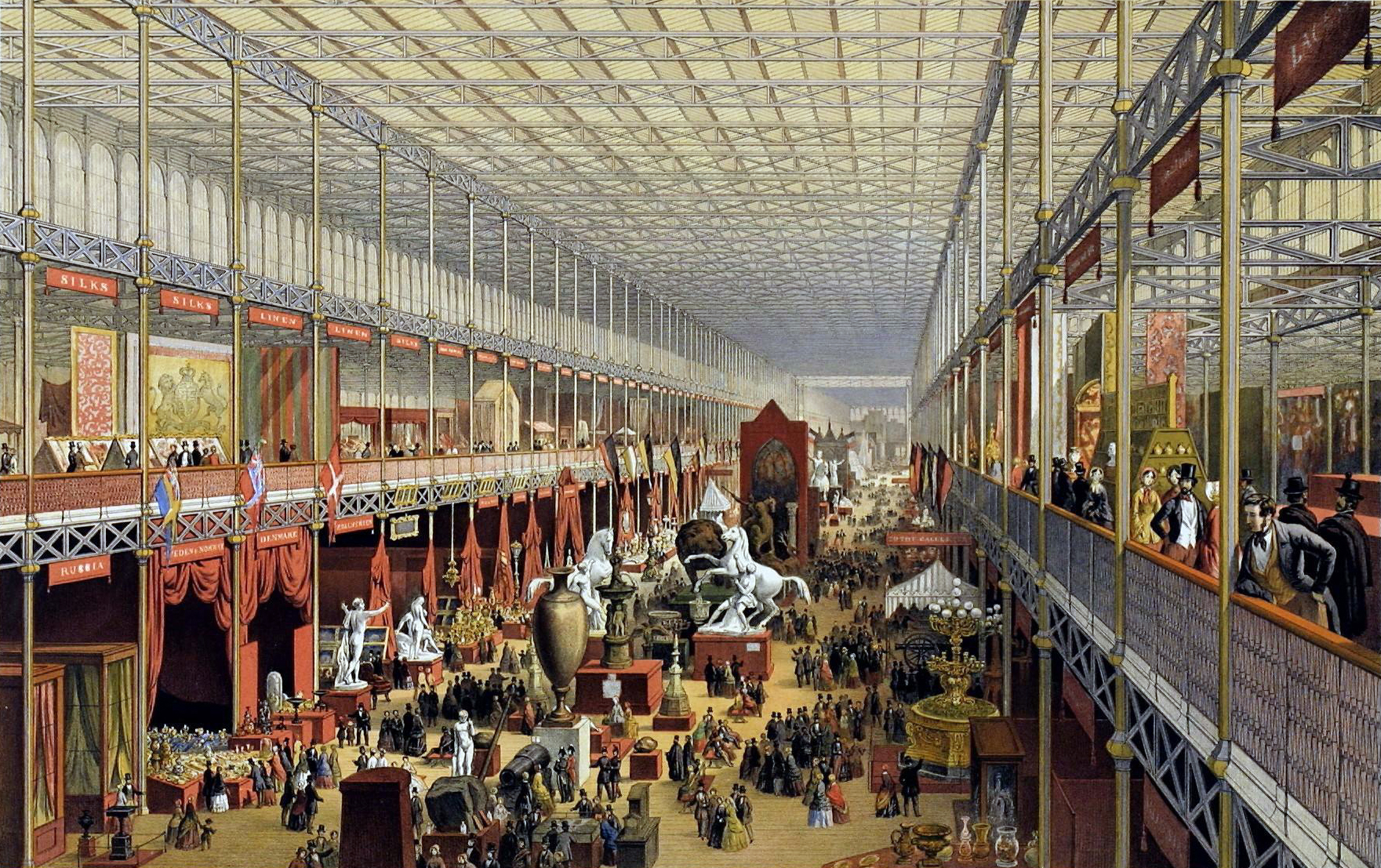
Reflections is the unit we began right after wrapping up the alternatives and we began with the infamous Baroque period. We talked about points that characterized the Baroque movement and those included: rich in fabrics and textures, excessive, ornamentation, applied surfaces, detailed oriented, made for the wealthy, a commonality in material selection, tapestry, and lastly stately. After defining what exactly Baroque was we moved into the structures that were built around that idea, and we looked at three different countries that were doing their own thing with it. The first being the Palace of Versailles in France which construction was done in four different campaigns with the first beginning in 1664. This is probably one of the more known sites because it features the spectacular hall that includes in total 357 mirrors. Next we moved to the country of England and there they had built a structure that is believed to be the best location of the prime meridian, and that is the Greenwich Observatory. The site overlooks the River Thames and it has played a significant role in the history of astronomy and navigation. Lastly we looked at the colonial North America and what was happening here, and we see the Palladian style still being used in the shape of Drayton Hall in South Carolina. From there we focused primarily on our country and what was just beginning to happen then starting with the Virginia Capitol Building built in 1785 by Thomas Jefferson. Another building, that which is a school also built by Mr. Jefferson is the University of Virginia and this site is a landmark because of it’s rotunda which originally was the schools library. We also talked about other buildings that were happening around the same time such as Monticello, the US Capitol, and the White House. Next we move to a new technology being produced within buildings, actually two technologies. Those technologies being the introduction of glass and iron which allows for a greater span, various shapes but along with its benefits comes disadvantages too. The first large-scale structure using wrought iron obersevred in class was the Kew Gardens; also features panes of glass throughout that are all hand-blown. From there, glass was being used in many different ways, and in many different forms. One of the most renowned places we talked about was the Crystal Palace built in 1851 for the Great Exhibition. It was constructed entirely out of cast-iron and glass and housed more than 14,000 exhibitions within which led the structure to span 1,851 feet in length. Somewhere along in the unit as well we talked about revolutions and I would say that the introduction of glass and iron created a revolution, it allowed for new creations, new ideas, different ways of doing things and from there it only progressed up (literally). Reflections is defined as a fixing of the thoughts on something, or simply just an image. You look at a mirror, you get a reflection cast back directly at yourself and that’s what I think this unit was about. It was about the present looking to the past for guidance and ideas but somewhere along the way, your view gets distorted and sometimes that can be good and other times not. Reflections are tricky because you want to dwell back on something that’s good and proves useful in its present era, you don’t want to revive something that has no use or sense being revived. 


11.03.2010

Reading Comprehension #5

[1] From the Roth, Harwood, and Massey readings, select an ARTIFACT you believe to represent revolution in design. SPECULATE about the type of revolution this artifact symbolizes. Supplement your answer with a beautifully hand rendered image of the artifact you selected, citing source and page on your image. [10 POINTS POSSIBLE]


Architecture and Interior Design Through the 18th Century: Harwood
pg. 313
The kitchen cupboard was an ARTIFACT which was used by the Germans as a form of storage. Typically a cupboard is a cabinet in which food, textiles and such were housed in to protect them from dust and dirt. However the one pictured above is more commonly known as a pewter cupboard because it consists of drawers and cupboards in the lower portion. And among the top there are a series of shelving units. These were used more to display crockery, silverware and general ornaments rather then hiding them away in the cupboard. I believe this piece is a revolution in some ways because before this time people really didn’t have a means by which to organize or display their belongings. In the American Colonial time people start having possessions in which they are now needing a solution to store them with, thus is the reason this product arose.
[2] Using the internet, LOCATE and ANALYZE an image for an ARTIFACT, a SPACE, a BUILDING, and a PLACE, drawing the idea of eastern influences as understood by nineteenth-century minds (China, Japan, India, Middle Eastern) on western design and architecture. Each answer must include an appropriately annotated and cited image in addition to a well-crafted essay to defend your choice of each image and the ways (more than one) that the material item responds to design influences from the east. [20 POINTS POSSIBLE]**


ARTIFACT


Porcelain was an artifact that wasn’t necessarily adapted to the western world, it was an object that was literally exported from China and other places. Typically the merchants vessels would deliver their cargo in New York and pieces would include coffeepots, soup tureens and eggcups. From there people would brighten up their houses with these colorful objects and display them for guests they had over. 

SPACE


Chinoiserie is a theme that occurred in Europe often which reflects Chinese artistic influences. It features contrasts of scale, asymmetry, and attempts to imitate Chinese porcelain. And no other western interior space exemplifies this more then that of the Royal Pavilion in Brighton, England.

BUILDING


While the interior displays Chinoiserie the exterior speaks a completely different language and that interior takes shape in the Indo-Saracenic style which is mainly prevalent in India. It has common features such as the finial, onion style dome, a drum, arches, and other things as well.  

PLACE


Lastly coming full scale to the place of this we have the Great Exhibition of 1851 in Hyde Park, London. This was the first in a series of World’s Fair exhibitions of culture and industry innovations and creations. The entire event was held and coordinated in the Crystal Palace, and there were 13,000 exhibits total that expanded from Austalia, India, Denmark and many many other countries and places. So of course this because like a jambalaya of design because you had so many different countries and so many ideas under one massive spanned structure. 

10.31.2010

The Hall of Mirrors

After the perspective counterpoint in history we were then supposed to create a clock and for my scale I chose a space in the paragraph form. With a clock I looked up mirrors and exactly how they functioned and I felt like Versailles was a good location with a rich history behind it. 


10.25.2010

POINT: ALTERNATIVES

“Genius is eternal patience”
-Michelangelo 


Once we left the foundations unit in class, we then proceeded to the alternatives unit which encompasses the Gothic and Renaissance period. The dictionary defines alternatives as “a choice limited to one of two or more possibilities, as of things, propositions, or courses of action, the selection of which precludes any other possibility.” Basically in layman’s terms this in my mind means that the people are taking what has already been built in society and altering it to create something new, yet refined. And the first era we dove into was the Gothic style and mostly that around France, the first site was that of the Amiens cathedral. The cathedral embodied so many different elements within it, and that probably is because throughout its construction it had three different architects. Carcassonne was next, and it is a town that was completely fortified, having only two outer walls that confine an entire location. Among other castles covered was that of Dover Castle, Stokesay Castle and Burg Eltz in Germany. After leaving France we got to the work from Italian architect Andrea Palladio and what he did at Villa Capra. Villa Capra mimicked the Pantheon in many ways but it considered all axises rather than two. Palladio was a person that brought villa’s to what we really know them as today by refining them in every way and eventually it led to a whole style known as Palladian architecture. Villa Barbaro was another villa, not done by Palladio though. This villa followed the same blueprint a standard villa would, except it shrunk in one dimension and gained much more in its overall horizontality. San Giorgio Maggiore is an island in Italy which is home to another Palladio structure. This one being the Church of San Giorgio Maggiore; and at this church you have a facade that is exceptionally white and is a temple manner. And also the facade has two faces that Andrea translates into one superimposed face. Next a site we covered that I really seemed to enjoy was the one in France known as Chateau de Chambord. And this building has really two styles that are being froze in its exterior; the first being the top and it is of the castle style and the lower portion being along the lines of neoclassical. Departing from France we looked at the Palace of Charles V in Spain and then Hardwick Hall in England. And looking across these three places you see just how different each country is building and how that carries on throughout their land. And finally our last stop in the alternatives section was at Florence, Italy and was a church by the name of Santa Maria Novella. Another stop we made in Italy was the home and the Medici family and their palazzo. This buildings features a facade that in divided into three parts that is emphasized by a horizontal band. In class we had wrote down the top ten rules of the Renaissance and they were as follows: single decorative facade, reviving the classics, man is the measure of all, separation of spaces, harmony through repetition, geometric patterning, patronage dominates the building industry, no building is one single style, boundaries/edges/borders are all vital, and finally separation of public/private. And I think throughout the entire span of the alternatives unit all of these guidelines are followed for the most part. So foundations are what we build upon but on those foundations we make alternatives for the entire world to see and the alternatives are still with us today. They just get translated so differently that we have the mindset that it's something completely different but really it's still home to some of those roots from previous eras. 

10.19.2010

A Perspective Of San Giorgio Maggiore

Okay so this is now the second project for history that pertains to the alternatives unit, the last one being a compass and this one being a perspective. For this 8.5 x 8.5" I chose a place in Italy known as San Giorgio Maggiore which is my SCALE. And for the form I chose WORD and I chose to do some more digital manipulation with the island itself and I ended up liking the overall result. 


10.18.2010

Reading Comprehension #4

[1] Just as we learned with Gothic cathedrals, in the context of each PLACE, the other scales of analysis (ARTIFACT, SPACE, and BUILDING) each demonstrate difference. For each scale on the readings rubric above, EXPLAIN at least one common design language that links them all. Use the principles and elements of design as defined for this class in your response. Explicitly tie the Roth reading to your analysis, using at least one cited quote. [10 points possible]


For the scale of artifacts amongst the five different styles I see lines being an element that is evident in all of them. From the desk incorporating all of the drawers, to the chair that has lines that embodies the entire piece; especially the backing. Next you have the clock that has vertical lines that are far more prominent that the horizontals of the object. Then there is the state bed that has lines that are most noticeable in the four posts that rise above the bed to hoist the shelter that encloses it; lastly you have the Sheraton side chair that also embodies lines in the same aspects of the Windsor chair. 
The next scale is that of physical interior spaces, and for this I can see many different principles such as space itself, texture, balance. Texture is the one I find most interesting because texture is something we know about but we don’t really pay attention to just how much texture is around us and what’s different about each and every one of those. And the interior’s are where you’ll find many different textures from the floor whether it’s wood, carpet, tile to the specific furniture and upholstery that is applied to that piece. And all of these examples incorporate texture in many different ways, and also many similar ways. 
Next there is the building scale and across these five different styles I believe repetition is one that you could argue. In most of these examples you’ll find columns, windows, brick work even that creates that sense of repeating something. It’s the way that element is chosen to be echoed on how it will affect the entire composition.
Lastly there is the place scale and since it is on a city wide scale it’s hard to determine certain principles or elements. But any city in it’s whole most likely embellishes that sense of unity with the entire city coming together, from it’s houses to whole blocks to whole areas to eventually it’s outer most limits. Also you’ve got contrast for sure in all of these places, not everything in a city looks exactly the same. You’ve got homes, houses, apartments, commercial complexes and whatever else that gives it a certain flare. 

[2] Linked to Europe, the ARTIFACTS, SPACES, BUILDINGS, and PLACES of the American colonies echo closely their design forebears. Selecting evidence from all four scales for both the American Georgian periods, TRACE the common design ancestry across the Atlantic Ocean in the Neo-Palladian and Late Georgian periods of England and the Louis XVI/French Provincial period in France. ARTICULATE the implications of copying from Europe for the American colonies. Use the principles and elements of design as defined for this class in your response. Explicitly tie the Roth reading to your analysis, using at least one cited quote. [10 points possible]


When the English arrived to the Newfoundland they established colonies along the eastern seaboard. And with those new colonies that were being formed they reproduced the houses and furnishings they knew from their homeland. Using different materials for different purposes such as timber; they still managed to keep a consistency with there profound lines and symmetry in many different scales across Boston. 
Next we have the Spanish and when they arrived they settled in the southwest and also Florida. More than the other colonists, the Spanish adopted local traditions and also developed a distinct architecture in numerous colonies. Although the forms somewhat stay consistent with what they know the materiality changes somewhat where in Spain you see mostly stone work and then in the new land you start seeing the use of adobe. And also in the furniture the consistency is clearly evident with carving being brought into many of the pieces once they were settled in their new environment. 
The French settled in the Gulf of Mexico and also near the mouth of the Mississippi which brings us the New Orleans, Louisiana. The French were also similar to other settlements being that they recreated what they knew from their mother country. Their interiors and architecture were pretty simple but their furniture however borrowed from the high-style pieces. They also incorporated many techniques that they already had developed such as the steep pitched roof and half-timber construction. 
Lastly we come to the Germans/Hollands that settled primarily in New York and Pennsylvania. German settlers, like the English brought over native medieval building and furnishing traditions to America. Once again when the Germans arrived in America they explored different materials; this material being wood rather than stone that was common to the homeland. The interiors of German homes were fairly simple but often colorful and walls were often whitewashed as well. 
[3] From the Hersey/Freedman reading, DESIGN and POST a labeled floor plan of a possible Palladian villa inspired by Girolamo Frescobaldi’s Balletto Terzo found online at this site: http://www.metmuseum.org/toah/hd/renm/hd_renm.htm select the link on the left side of the page with Frescobaldi’s name under multimedias [5 points possible]

[4] Using the resources at the weblink below, SPECULATE about whether you believe that the architecture and design in the Baroque period stands as a form of social performance in the theatre of the world. Support your response with examples from class and the assigned readings. [5 points possible] http://fathom.lib.uchicago.edu/2/10701023/

Theatrum mundi is the term that I noticed most in the reading that translates to, the world is a stage. And I believe throughout the Baroque era this is what you see done, but it is done in the form on a solid architectural form. They take what is done on a stage by human beings and somehow attempt to mold that into a valid, structural place. Some common design characteristics in the Baroque period was a stronger emphasis on curves as well as more decorative details and ornamentation. Movement was something they tried to embody as well as optical illusions and many other things too. If you think about all these things you can somehow interpret it into something that a person would do in a theatre setting. Curves firstly, we as humans don’t move in a straight line, we do it in a very fluid and natural sort of manner. Next, theatre life is very planned and very organized to put on a good show and there is tons of movement that is captured throughout a performance. So yes, I believe very much so that the Baroque era was a form of social performance in every single way; you are witnessing a theatrical performance being paused and then shaped into a habitable and purposeful space. 

10.06.2010

POINT: FOUNDATIONS

"Beauty will result from the form and the correspondence of the whole, with respect to the several parts, of the parts with regard to each other, and of these again to the whole; that the structure may appear an entire and complete body, wherein each member agrees with the other, and all necessary to compose what you intend to form."

-Andrea Palladio


Upon leaving the theories unit in history in which we discussed Stonehenge and what not; we then proceeded to enter the foundations unit. Before getting into the foundations unit we had talked about building methods in which we had already explored. Those methods we had covered were circles (Stonehenge), lines (Hypostyle Hall), and finally stacking (Pyramids of Giza). And the foundations unit began with the first settlements really; those settlements would be Mesopotamia, China, Ohio Valley, and Teotihuacan. And in these the early settlements you had different forms appearing and also some common ground, in China you had a wall that was basically used to divide and identify a boundary among the land. In Ohio Valley you had a massive landmark that took the shape of a serpent. And another was Teotihuacan in which you actually had residential complexes being shaped and pyramids as well to form one larger inhabited city one could say. Then next we enter the legendary Greece in which we see the first area of Europe to have advanced civilizations emerge. And because of this we see things that are new but still borrow a little from previous. Incorporating some combinations of stacking, lines and also circles depending on how you look at it. Seeing these forms couldn’t be more justified than by looking at the site of Acropolis where you’ve got the Parthenon, Propylaea, Erechtheum, and the Temple of Athena Nike. After departing from Greece we enter Rome and it’s different I’d say. It’s about new technologies, materials, forms, living with the past and adapting to the present. And in Rome we see the first uses of concrete and vaulting and a new, exciting form... the dome. Possibly the hands down, most recognized structure in Rome is the Pantheon in which you’ve got a temple facade slapped right on the front of a massive dome backing the structure. Inside of the structure you’ll find a ginormous circular area which features a coffered dome that leads your eye upward to a gorgeous open oculus and allows the space to be naturally lit and lit differently depending on the suns direction. Throughout Rome you have new forms and techniques that appear; those being: bath, market/forum, basilica, coliseum, arch, temple, aqueduct, villa, dome, road and lastly the mosaic. So I think that’s basically in a (nautilus) shell that’s what the foundations unit covers. It’s about establishing what can be done and what will be done for hundreds and hundreds of years after they’ve passed on. It’s about leaving your mark as in Egypt, or bringing forth a tradition and passing on a legacy for others to follow as seen in Greece, and lastly it’s about being new and almost “modern” like in your ways and completely doing things in a new and upbeat sort of way like Rome. Foundations are what structures essentially are built upon and from there we can only build up or out and we have to choose from that foundation what we will do, whether it be something completely different and unseen or it be something that borrows on previous forms/structures.